Articles
/ 12 October 2026
Small Sample, Big Step: Why Ingredient Samples Matter
Infos

Choosing a fruit puree is not simply about selecting the right fruit.
For food manufacturers, the quality of a puree can directly influence the taste, appearance, texture and consistency of the finished product. It also affects how predictable your production runs are, how much reformulation work your R&D team has to absorb, and how confident your quality team can be about the next delivery.
So, what should you look at when selecting a fruit puree and a supplier? Six parameters cover most of the ground.
Brix is one of the key parameters when working with fruit puree. It gives an indication of the soluble solids content and helps manufacturers ensure consistency in their formulations.
Keeping this parameter within the agreed specification is particularly important when the puree is used at a defined dosage: a variation in Brix means a variation in the dry matter you are actually adding to your recipe, and therefore in sweetness, water balance and final yield.
Ask your supplier not only for the target Brix, but also for the tolerance range and how it is monitored across production.
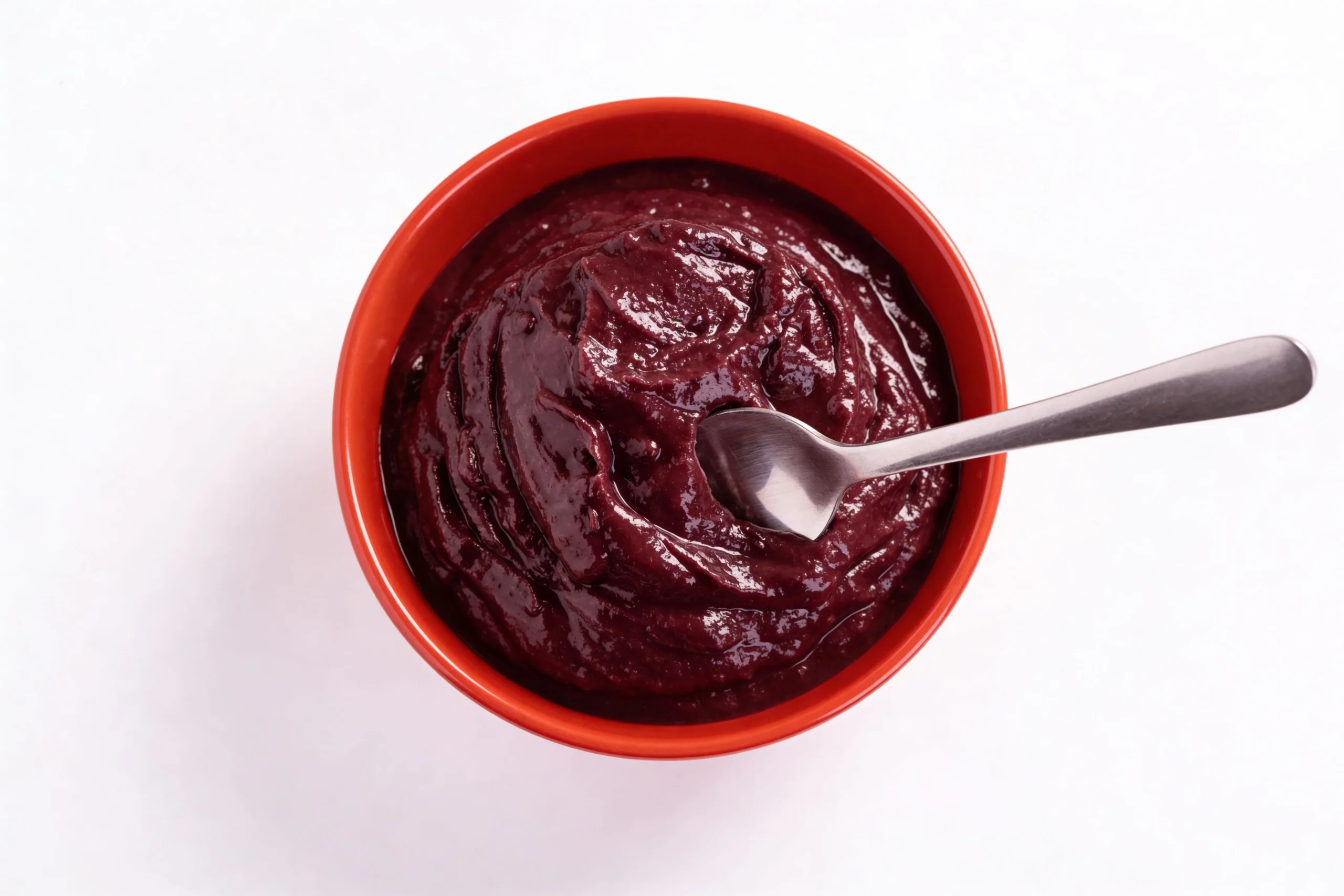
Fruit is a natural raw material, so some variation in colour can occur depending on the fruit, the variety and the harvest.
However, consistent appearance remains important for manufacturers, especially when the puree contributes visibly to the finished product — in a fruit layer, a filling, a topping or a beverage. The supplier should therefore have clearly defined specifications for colour and appearance, and be able to explain what causes variation and how it is controlled.
The puree should deliver a characteristic and consistent fruit profile. This is particularly important when fruit is a key part of the finished product and a driver of the consumer promise on pack.
When evaluating a new puree, sensory evaluation can be just as useful as technical specifications. Two products meeting the same numerical parameters can taste noticeably different. The ingredient should deliver the flavour profile expected for the application and remain consistent from batch to batch.
Texture can be an important consideration depending on the application. A puree used in a filling, sauce, dessert or beverage may require very different characteristics: a bake-stable filling and a drinkable smoothie base have almost nothing in common in rheological terms.
Understanding how the puree behaves in your specific process — pumping, heating, shearing, filling — is therefore essential. Ideally, the ingredient should be evaluated in the final application rather than judged only on its specification sheet.
The quality of a puree starts with the fruit itself.
Fruit variety, origin, maturity and harvest conditions can all influence the characteristics of the final ingredient. Understanding the raw material and how it is sourced can therefore help manufacturers assess whether the ingredient is suitable for their product and their target market — including for claims related to origin, organic certification or clean label positioning.
This is also where supply security is decided. A supplier with a clear view of its sourcing is better placed to anticipate a difficult harvest than one buying opportunistically.
Perhaps the most important question is simple:
Will the product perform the same way next month as it does today?
For industrial food manufacturers, batch-to-batch consistency is essential. It is what allows a recipe to be locked, a line to run without adjustment, and a finished product to remain recognisable to the consumer.
A reliable supplier should have appropriate processes in place to monitor the quality of incoming fruit and of the finished puree, ensuring that the agreed specifications are maintained over time — and should be transparent when a deviation occurs.
When selecting a fruit puree, it is important to look beyond a single technical parameter. Brix, colour, flavour, texture, raw material and batch-to-batch consistency all contribute to the performance of the ingredient, and they interact with one another.
Ultimately, the best puree is not necessarily the one with the longest specification sheet. It is the one that consistently performs as expected in your application.
At Solufruit, we work with food manufacturers to provide fruit purees — including date, prune, fig, raisin and apricot purees — adapted to their formulation, process and specific requirements.
Looking for the right fruit puree for your application? Get in touch with our team.